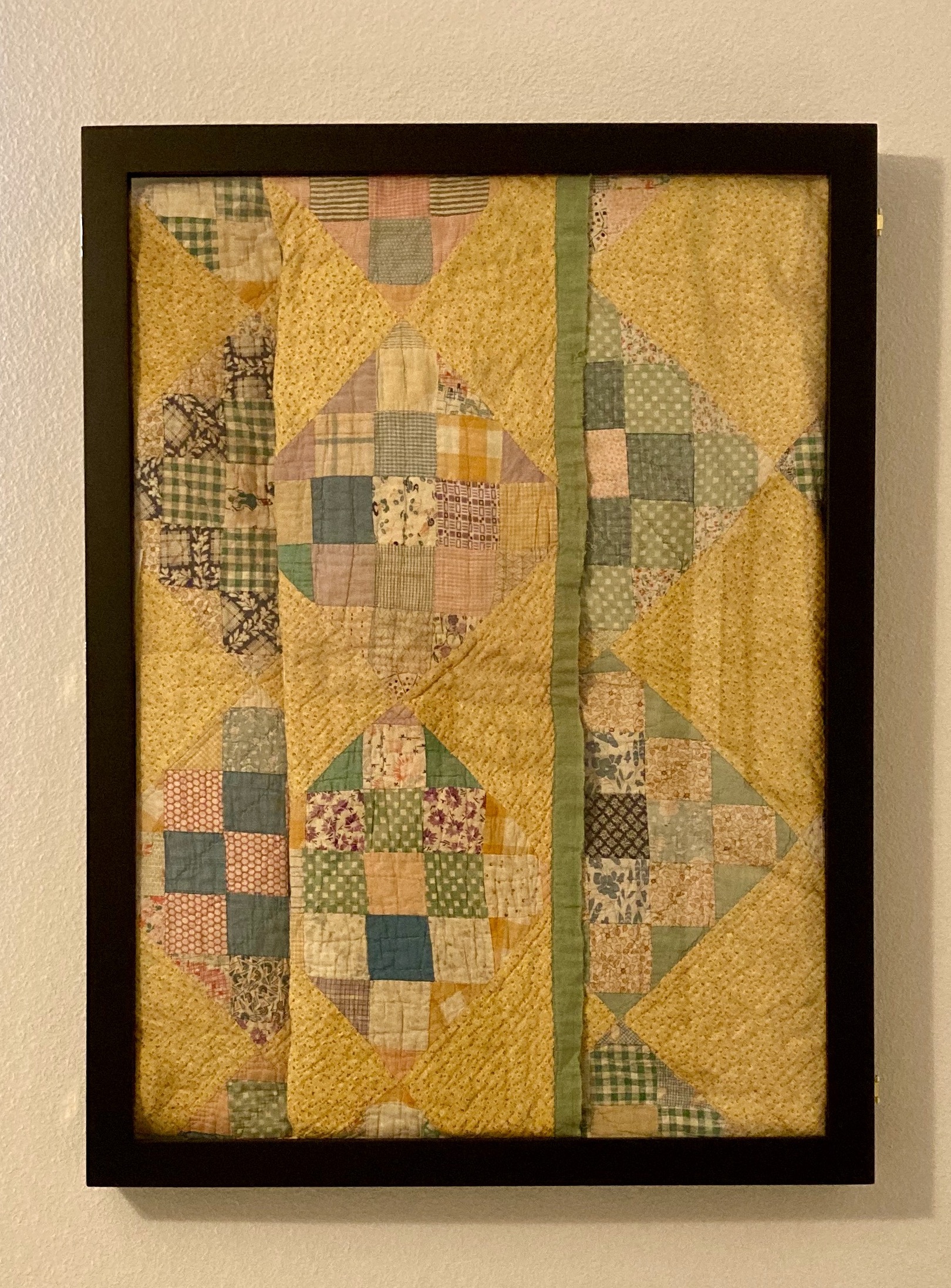
In going through her home in preparation for a move, my mother recently unearthed a quilt I had never seen before. It was made, entirely by hand, by my great-grandmother, Maggie. She was born in West Virginia in 1873, and would have made this quilt while living in Brevard, NC sometime in the late 1930s to early 1940s. My mother used it as a child, and even took it to sleep under in her dorm room at the University of Kentucky in the late 1950s.
The quilt is in pretty terrible shape. The colors are faded, the binding is frayed all around, the batting is disintegrating, there are stains on almost every block, and there are places where the fabric has worn away to just a few threads. But it's the work of a woman I never knew, whose blood flows in my veins, and when I turn it over, I can see every painstaking stitch made by her hands over 80 years ago. How could I throw it away?
I considered a couple of options: Cutting the pretty, pieced blocks out and framing them individually to be distributed among family members, or having it professionally conserved and packing it away to keep any further harm coming to it. After consulting a cousin who is also a descendant of Maggie, I decided against taking scissors to it. (I couldn't really see myself doing that, anyway.) But I also hated the idea of hiding it away in a box, where no one could enjoy it at all anymore.
My solution was a compromise between conservation and display: It is now inside a shadow box - the kind used to display sports jerseys - with UV-resistant glass, and I tucked archival-grade tissue paper into every fold to protect the fragile fabric. It's hanging on a wall that does not get direct sunlight, and carefully folded to show the prettiest squares.
In this way, the quilt can be admired for at least a little longer, and passed down to the next generation of Maggie's descendants.